


The Price of Pot: Breaking Down California Cannabis Taxes
California cannabis taxes are complicated, but we're here to help simplify them. When you purchase cannabis from a licensed California retailer like embarc, you may encounter several different taxes.
Cannabis purchases are subject to the state cannabis excise tax, regular state and local sales tax, and, depending on where you shop, a local cannabis business tax. And this is where things get confusing: you can't necessarily take the 15% cannabis excise tax, add your local sales-tax rate, and assume that's what you'll pay.
Some taxes and fees become part of the amount used to calculate the next tax. In other words, you can essentially end up paying tax on an amount that already includes another tax.
Long story short: California cannabis taxes can be confusing. If you want to learn more about the state’s taxes, where they come from, and where they're going, this guide has you covered.

California cannabis tax snapshot
California cannabis taxes begin with the cannabis excise tax, which is calculated on a retailer's gross receipts. Gross receipts are the total amount a retailer receives from a cannabis sale before sales tax is applied and can include more than just the listed price of the product.
From there, recreational purchases are generally subject to California sales tax, while local governments may impose additional taxes on cannabis businesses.
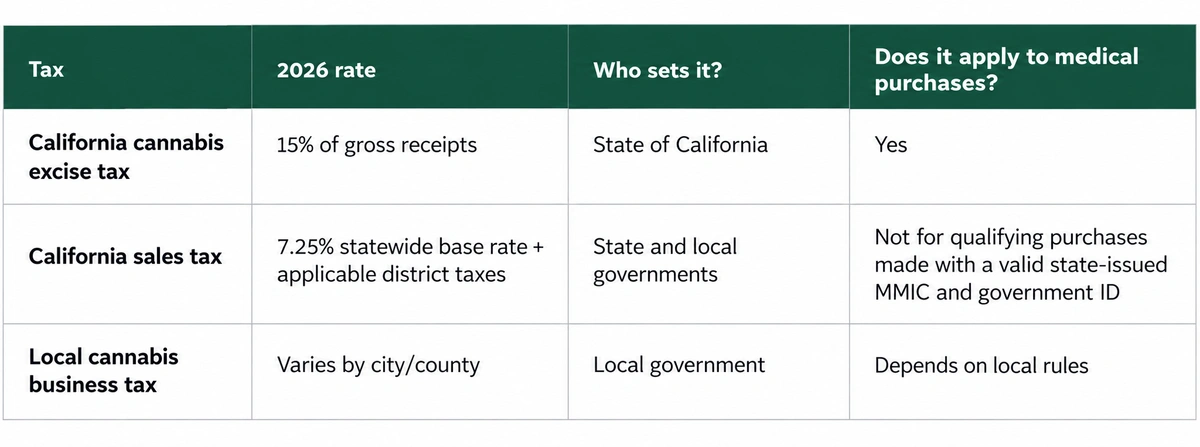
This table highlights the three main taxes you may encounter when buying weed in California in 2026.
How much is cannabis taxes in California?
There isn't one universal California weed tax percentage. At the state level, taxable retail sales of cannabis are subject to the 15% cannabis excise tax.
Most recreational purchases are also subject to the same general sales tax that applies to other taxable goods, while local governments can impose additional taxes on cannabis businesses.
That means the total weed tax added at checkout depends heavily on where you shop and how the retailer structures the transaction.
Recreational customers
Adult-use cannabis customers pay the 15% state cannabis excise tax plus applicable sales and district taxes. Depending on the retailer, customers may also see a local cannabis business tax passed through as a separate charge.
The tax itself is imposed on the cannabis business, but some retailers pass that expense along to customers. Sales tax also varies by location. California starts with a 7.25% statewide rate, with applicable district taxes added on top of that.
Medical patients
Medical patients are still required to pay California's 15% cannabis excise tax. However, with a
valid state-issued Medical Marijuana Identification Card (MMIC) and government-issued ID, qualifying medicinal cannabis purchases are exempt from sales tax.
A physician's recommendation alone does not qualify for the sales-tax exemption. Local cannabis business taxes may also apply depending on the jurisdiction and retailer.

How is cannabis tax calculated?
California's 15% cannabis excise tax is calculated on gross receipts, which generally include the selling price after discounts and other charges required as part of the sale. Depending on the transaction, that can include:
The selling price of the cannabis
Local cannabis business taxes passed on to the customer
Certain delivery charges
Other mandatory charges related to the sale
The excise tax is added to that amount, and sales tax is then calculated on the total, including the excise tax. This is why the percentage added at checkout can be higher than simply adding the 15% excise tax to your local sales-tax rate.
Illustrative cannabis-tax example
For example, say a city has an 8% cannabis business tax and an 8.75% sales-tax rate. If a retailer passes the business tax on to the customer, a simplified $50 purchase could look like this:
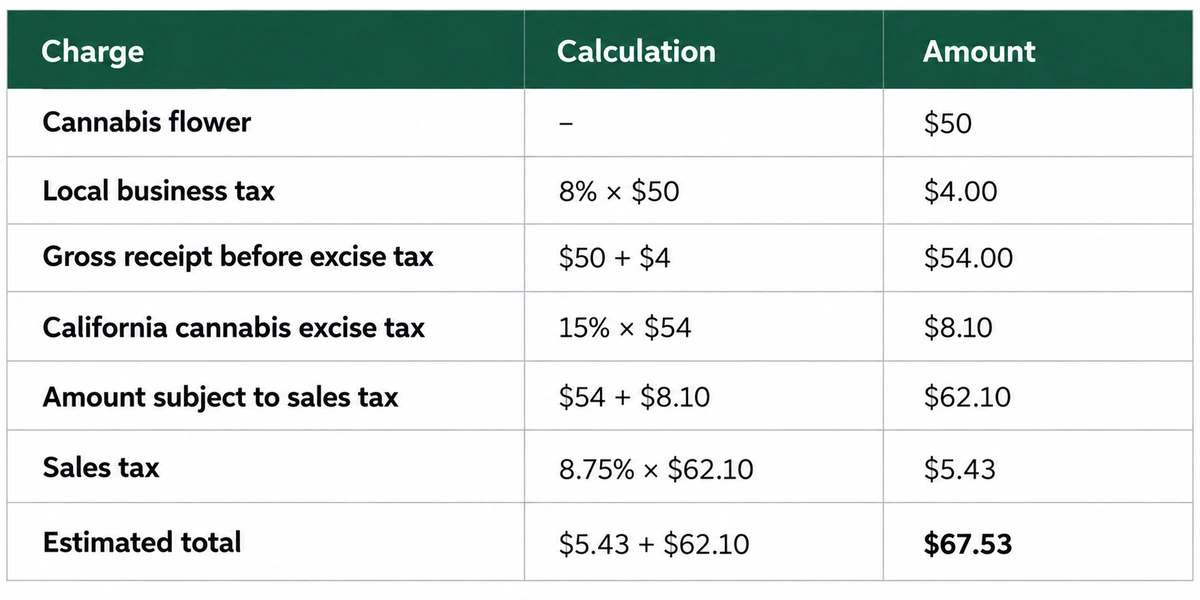
This is a simplified example. Actual rates, taxable fees, discounts, and rounding practices vary.
Why do cannabis taxes vary by location?
California's cannabis excise tax rate is 15% of gross receipts for taxable retail cannabis sales in 2026, but two other pieces of the tax structure can change depending on where you purchase cannabis.
Local sales and district taxes
California has a statewide sales and use tax rate of 7.25%, but cities, counties, and other taxing districts can add district taxes. That's why you might see an 8.75% sales-tax rate in one city and a rate above 10% somewhere else.
For example, the City of Riverside's rate is currently 8.75%, while California's 2026 rate table includes jurisdictions ranging from the 7.25% statewide minimum to more than 10%.
For deliveries, the applicable district tax can also depend on where the cannabis is delivered, not just where the dispensary is located. That means your delivery address can ultimately affect your final bill total.
Local cannabis business tax
Cities and counties can also impose their own taxes on cannabis businesses. These aren't uniform across California.
Local governments may tax cannabis retailers based on gross receipts, set different rates for different types of cannabis businesses, or choose not to impose a cannabis-specific business tax at all.
This is why different embarc locations can have different tax structures even though they're all operating under the same California cannabis laws. One city may impose a higher cannabis business tax than another, and the applicable sales-tax rate can change too.
Changes in California’s cannabis taxes
California's cannabis tax structure has changed several times since adult-use sales began. Proposition 64 established a 15% cannabis excise tax along with a separate cultivation tax.
In 2022, Assembly Bill 195 eliminated the cultivation tax and restructured how the excise tax was collected. Beginning in 2023, cannabis retailers became responsible for collecting and remitting the tax based on retail gross receipts.
The excise tax briefly increased from 15% to 19% on July 1, 2025, before Assembly Bill 564 returned it to 15% on October 1, 2025, and delayed another required rate adjustment until the 2028–29 fiscal year. For 2026, the cannabis excise tax remains 15% of gross receipts.
How are cannabis taxes used in California?
Under Proposition 64, cannabis tax revenue first funds specified regulatory costs and programs. The remaining revenue is generally divided into:
60% for youth education, prevention, and treatment programs
20% for environmental restoration and protection
20% for public safety, including impaired-driving and law-enforcement programs
For example, in 2026, California awarded $227 million through the Proposition 64 Public Health and Safety Grant Program to local government. The funding supports programs ranging from youth prevention and public health to environmental protection and enforcement against illegal cannabis operations.
In Humboldt County, previous Proposition 64 funding helped support youth education and enforcement efforts that removed more than 267,000 unpermitted cannabis plants and identified 188 environmental violations.
Local cannabis business taxes are separate, and how the city or county spends that revenue depends on the jurisdiction.
California Cannabis Taxes: Your Dollars At Work
Taxes are inevitable—they're just another part of life. Cannabis taxes may sting at checkout, but that money supports programs at both the state and local levels, from public safety and youth programs to environmental restoration.
The next time you buy weed at embarc, at least you'll have a better idea of what you're paying, why you're paying it, and where that money goes.